
A focused practice for managing security across cloud-hosted business applications involves continuous assessment of configuration, identity, and access settings to maintain an acceptable security posture. This discipline collects telemetry from multiple software-as-a-service platforms, evaluates settings against policy baselines, and presents findings as prioritized issues. The aim is to increase situational awareness about where applications may expose data, where controls are weak, and where administrative settings diverge from organizational rules, so teams can address the most consequential gaps first.
Operationally, this approach typically combines automated scanners, connectors to SaaS APIs, and analytics that surface deviations from expected configurations. It often incorporates identity signals such as privileged account activity, third-party integrations, and service-to-service credentials. Outputs frequently include a risk register or dashboard that groups findings by severity, affected application, and suggested remediation paths. The process may also feed into compliance workflows to demonstrate continued adherence to internal or external standards.
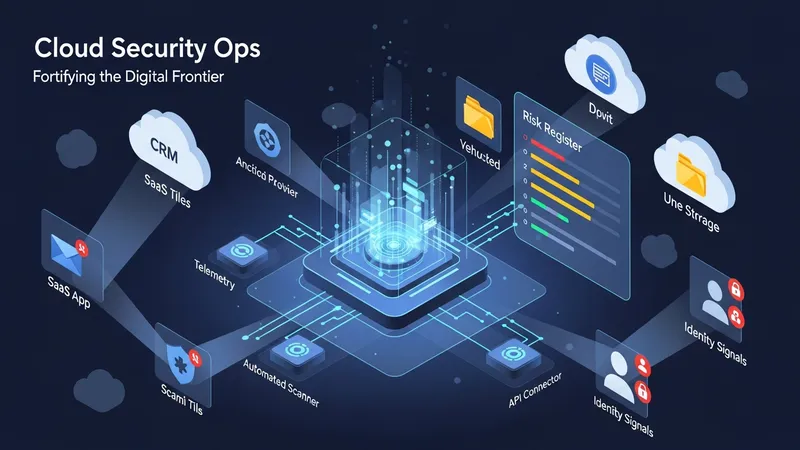
Continuous monitoring may provide near-real-time visibility into application changes and usage patterns that static audits miss. In many environments, frequent API polling and event-driven ingestion can reveal newly created integrations, altered sharing policies, or sudden increases in data access by external collaborators. These signals can be correlated with known risk indicators — for example, newly provisioned service accounts or scope expansions on delegated OAuth tokens — to prioritize investigation. Monitoring outputs often feed ticketing or incident response systems so that remediation can follow established operational procedures.
Configuration assessment typically focuses on settings that commonly expose data or weaken control, such as public file sharing, broad administrative roles, or disabled security features. Automated assessments often apply a baseline or policy template and then score deviations to help teams triage. Because many SaaS platforms offer different configuration surfaces, assessment tools may standardize findings into common categories (access control, data handling, integrations) so that security teams can compare posture across disparate applications without requiring deep product-by-product expertise.
Identity and access governance workstreams usually examine who has access, how access is granted, and what integrations have been authorized. Reviews may reveal stale accounts, excessive group memberships, or third-party apps with broad scopes that were granted long-lived tokens. These findings can be framed as entitlement risk and prioritized by the sensitivity of the data or the role's level of privilege. Governance approaches often combine periodic reviews with automated alerts when high-risk changes occur.
Compliance monitoring and policy enforcement link posture findings to regulatory or organizational requirements by mapping misconfigurations and identity risks to specific controls. Reports may show control status over time and help build evidence for audits. Because compliance frameworks vary, many teams select a limited set of rules to monitor continuously and leave less critical checks to scheduled reviews. This layered approach can reduce the time auditors spend validating routine controls while keeping attention on changes that materially affect compliance posture.
In summary, the practice centers on continuous visibility, assessment, and governance of cloud-hosted application settings and identities so that organizations can detect, triage, and remediate SaaS-related risks more efficiently. The examples listed above illustrate common tool and method categories often used together to create an operational posture program. The next sections examine practical components and considerations in more detail.
Continuous visibility focuses on collecting telemetry from application APIs, activity logs, and integration endpoints to form a near-real-time picture of configuration and usage. Many organizations find that automated connectors reduce the manual effort needed to inventory applications and integrations. Common patterns include ingesting audit logs where available, using API-based configuration snapshots, and watching for high-risk events such as mass file downloads or sudden OAuth consent grants. Consideration: filter and tune collected data to reduce noisy alerts and align monitoring outputs with the team’s operational capacity.
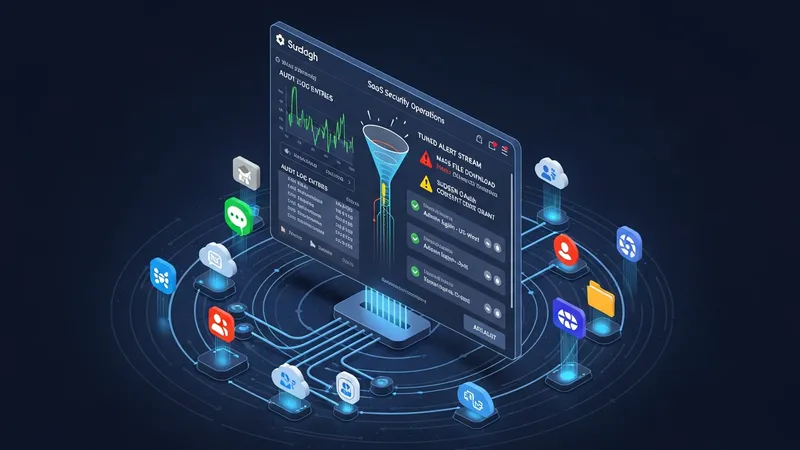
Practical considerations for implementing monitoring often include prioritizing high-value applications and establishing baseline sampling frequencies. For larger estates, teams may begin with the most critical collaboration and identity platforms, then expand coverage. Monitoring outputs can be integrated with existing security information and event management (SIEM) systems or presented in a dedicated posture dashboard. Analysts typically tune detection rules over time to reduce false positives; this tuning may involve whitelisting expected administrative actions or contextualizing alerts with user role information.
Many published surveys and incident reviews indicate that a notable share of cloud-related incidents involves misconfigurations or credential misuse. While exact figures vary by study, typical guidance is to assume configuration drift will occur unless actively monitored. Organizations often adopt a model where alerts about sensitive changes — such as permission escalations on shared resources — trigger an automated evaluation of potential impact, which can then be escalated to a human reviewer when the risk exceeds predefined thresholds.
Insider considerations include building access controls around monitoring outputs: limit who can view or modify detection rules, and ensure that monitoring agents or API credentials themselves are placed under governance. It is often useful to document expected change windows and to coordinate with platform owners so that legitimate administrative activities are understood by security reviewers. These coordination steps can reduce friction and help ensure monitoring yields actionable insights rather than noise.
Configuration assessment tools scan application settings and compare them to policy templates or security benchmarks to identify deviations that may increase exposure. Since SaaS platforms differ in settings and terminology, assessment tools typically normalize findings into categories such as access controls, sharing, encryption settings, and integrations. Teams may choose to enforce only a core subset of settings continuously, with broader checks scheduled less frequently. Consideration: align assessment baselines with organizational risk tolerance and regularly update templates to reflect platform feature changes.
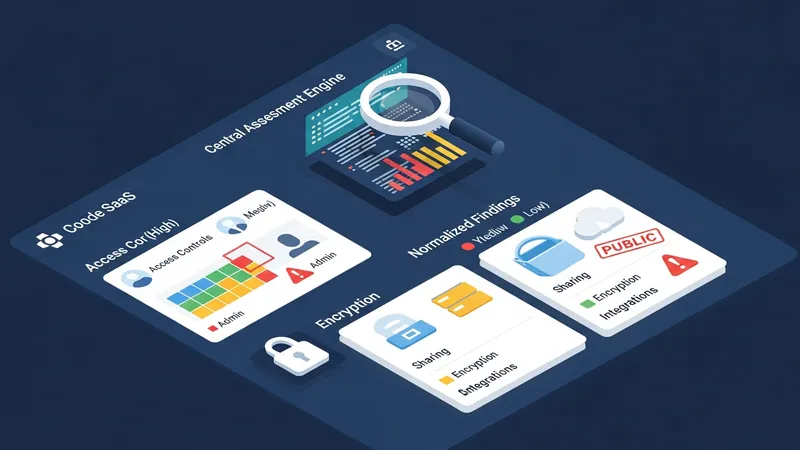
Misconfiguration detection often emphasizes high-impact controls such as public resource exposure, broadly permissive roles, or disabled security features. Detection can be automated to run on a schedule or triggered by configuration change events. Many organizations prioritize remediations by estimated impact and likelihood, such as addressing publicly accessible storage or administrator role misassignments before lower-risk issues. Assessment outputs frequently include remediation suggestions that platform owners can use to correct settings.
Operational patterns that reduce repeated misconfigurations include enforcing standardized deployment templates and using automation to apply secure defaults. While automation may minimize human error, it can also propagate a mistaken setting at scale if not properly tested. Therefore, a typical safeguard is to stage configuration templates in non-production environments and to include configuration reviews in change management pipelines before broad rollout.
Practical tips as considerations: maintain a catalog of high-priority applications, schedule periodic reassessments, and track when specific misconfigurations recur to identify systemic causes. Integration with incident response or ticketing systems can help ensure that discovered issues are assigned and tracked to resolution. Over time, organizations often refine detection thresholds and baseline policies to reduce false positives and focus on the most material configuration risks.
Identity and access governance in cloud-hosted applications centers on understanding who can access what and how access is granted. Key activities include entitlement inventories, periodic access reviews, and analysis of privileged accounts. In many environments, third-party app authorizations and OAuth scopes are a frequent source of risk because they can grant broad access with long-lived tokens. Governance methods often combine automated detection of risky entitlements with scheduled human reviews to ensure that access aligns with job function and business need.
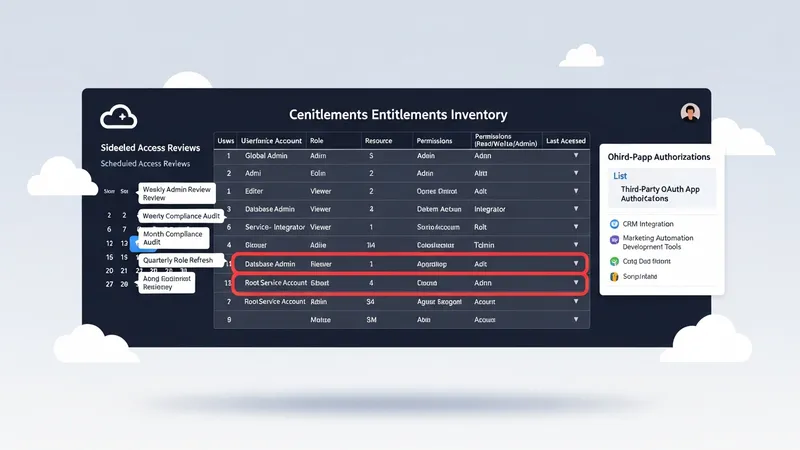
Common patterns include grouping users by role and applying role-based access controls to reduce individual exceptions, as well as tracking administrative actions separately from routine user operations. Identity signals such as sudden increases in failed logins, anomalous geographic access patterns, or unusual token issuance may be correlated with configuration and app-level findings to indicate elevated risk. Consideration: maintain an auditable trail of entitlement changes so that access decisions can be reviewed in context.
Practical governance tips often involve limiting service account scope, rotating long-lived credentials, and using short-lived tokens where supported by platforms. Periodic reviews can be scheduled based on the sensitivity of applications and the volatility of access changes. Some teams adopt a risk-scoring approach for entitlements so that reviewers concentrate on the highest-impact permissions first, while lower-risk items are reviewed less frequently.
Insider considerations include coordinating governance activities with HR and application owners to ensure timely updates when personnel change roles, and integrating governance outputs with incident response playbooks. Clear documentation of access policies and of the criteria used during reviews helps reduce disputes during entitlement remediation and supports compliance reporting when auditors request evidence of control.
Policy enforcement connects posture findings to organization-level rules and to applicable regulations by mapping detected issues to control objectives. This mapping helps teams prioritize remediation that has both security and compliance implications. Many organizations establish a small set of continuously monitored controls that represent the highest risk or most frequent audit requirements, while other controls are validated on a scheduled basis. Consideration: maintain versioned policy templates and document mappings so that evidence of compliance can be reproduced for audits.
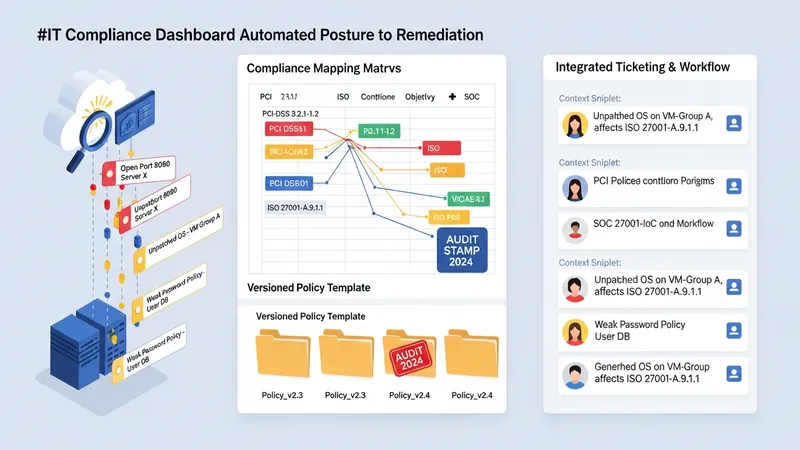
Operational integration involves feeding posture outputs into change management, ticketing, and incident response workflows so that identified issues are tracked to closure. Typical integrations include generating tickets with context-rich findings, attaching remediation steps, and updating risk registers. This reduces manual handoff and helps teams measure time-to-remediate metrics. Teams may also set service-level priorities that reflect business criticality to ensure limited resources target the most impactful items first.
Compliance mapping often requires translating platform-specific misconfigurations into standard control language. For example, a sharing setting or an OAuth consent may map to an access control or third-party risk control in an organizational framework. Maintaining these mappings as living documents enables consistent reporting and supports auditors who request samples of evidence. Consideration: include owners in mapping reviews so they understand how platform settings affect compliance indicators.
Final operational considerations include ensuring that enforcement mechanisms themselves are auditable and that any automated remediation is reversible and logged. When automated fixes are applied, retain change records and approvals to avoid confusion. Over time, teams frequently refine which issues are remediated automatically versus escalated for human review, balancing speed with caution to avoid unintended impact on business workflows.