
Organizations use a focused approach to assess and manage the security of cloud-hosted business applications and the policies that govern them. This approach collects configuration data, identity and access settings, and activity telemetry from multiple SaaS services to build a consistent view of risk and control posture. The process typically spans discovery of authorized and unauthorized applications, mapping of configuration settings against policy baselines, and the generation of prioritized findings that security teams can interpret. The emphasis is on continuous visibility into settings and relationships that may introduce exposure in a SaaS environment.
At its core, this discipline organizes controls and assessments to reduce configuration drift, detect misapplied privileges, and supply evidence for regulatory or internal compliance checks. Automation often plays a role in collecting APIs, scanning tenant and application settings, and correlating events across identity providers and service consoles. Outputs commonly include alerts about risky configurations, dashboards showing aggregate posture trends, and guidance that aligns observed states to organizational policy statements or compliance frameworks. The approach is frequently integrated with broader cloud or identity security operations to inform remediation planning.
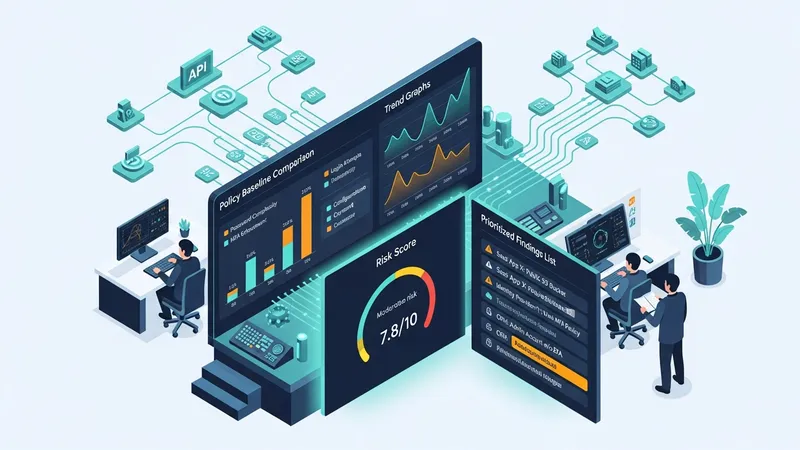
Configuration monitoring may cover items such as external sharing settings, API token scopes, session timeout policies, and application integrations. These scans often map observed values to a set of desired baselines which can be derived from vendor guidance, industry frameworks, or organizational standards. The mapping process typically includes severity assignment and a contextual description so that teams can prioritize corrections. In many implementations, integrations with ticketing or orchestration systems allow findings to be tracked and remediated with human review, reducing operational friction while preserving audit trails.
Identity and access governance functions look at user and service identities across connected SaaS platforms. Common checks include detection of multi-factor authentication gaps, excessive administrative roles, stale accounts, and unconstrained third-party access. Analysis sometimes extends to service principals and OAuth apps that may hold long-lived credentials. Because identity-related exposures can enable lateral movement or unauthorized data access, correlating identity findings with configuration issues often reveals higher-impact risks that warrant expedited attention by security teams.
Compliance assessment in this context often involves translating control statements from standards into verifiable checks against SaaS artifacts. For example, a requirement for least privilege can be operationalized by verifying that privileged roles are limited and that just-in-time mechanisms are used where available. Reporting functions aim to produce evidence that can be included in internal audits or external reviews, and may capture timestamps, API responses, and remediation status. Such reporting can help organizations track posture over time and demonstrate progress on control objectives.
Continuous monitoring and alerting provide the ongoing detection capability needed to respond to configuration drift and emergent exposures. Telemetry sources typically include SaaS provider APIs, identity provider logs, and cloud access security broker feeds. Correlation of events across these feeds can surface compound issues, for example when a configuration change coincides with a credential compromise. While automation may surface likely remediations, many organizations maintain human validation steps to reduce false positives and to ensure changes align with business needs.
In summary, this discipline brings together configuration visibility, identity governance, compliance mapping, and continuous monitoring to create an operationally useful picture of SaaS control health. It is oriented toward reducing misconfigurations, limiting excessive access, and supplying auditable evidence for controls. Adoption often proceeds incrementally, beginning with discovery and a small set of high-risk checks before expanding coverage. The next sections examine practical components and considerations in more detail.
Configuration discovery is a foundational capability that typically enumerates connected applications, tenant settings, installed integrations, and permission assignments. Automated connectors to provider APIs are often used to retrieve structured configuration data, which is then normalized so that disparate platforms can be compared against common baselines. Normalization may include mapping different role terminologies to a unified model and translating vendor-specific settings into security-relevant categories such as sharing, authentication, and logging. This capability may help teams identify where differing vendor defaults could introduce risk across a multi-vendor SaaS estate.
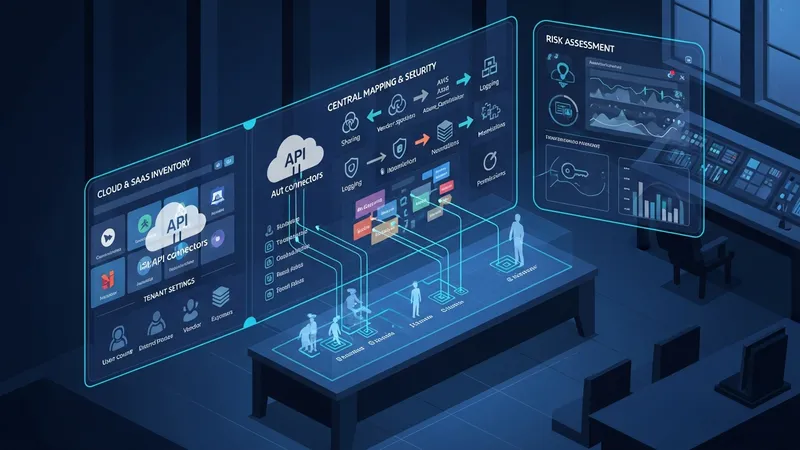
Risk assessment workflows convert discovered configuration and identity data into prioritized items for remediation. Scoring models often weigh factors such as the sensitivity of accessible data, the scope of exposure (number of users or external parties), and the presence of compensating controls like MFA or logging. Many organizations adopt tiered severity categories to align with incident response processes and to support resource planning. Risk assessments may be adjusted over time based on operational experience, emerging threat patterns, and audit findings to better reflect organizational risk tolerance.
Policy enforcement components translate organizational control statements into executable checks and, in some implementations, automated enforcement actions. Checks might include verifying that external sharing defaults are restricted or that administrative roles require specific approvals. Enforcement can be advisory—generating tickets and recommendations—or prescriptive where automated changes are applied under defined guardrails. Careful change-control practices are typically used when automated enforcement is enabled to avoid disrupting business workflows and to document exceptions and compensating controls.
Reporting and evidence capture consolidate findings into formats usable for compliance reviewers and operational stakeholders. Typical artifacts include timestamped configuration snapshots, lists of affected users or applications, and remediation status entries. These artifacts may be exported to standard formats or integrated with governance, risk, and compliance systems for lifecycle tracking. Reports often support trend analysis to show whether posture is improving or deteriorating, which can inform budgeting, staffing, or program priorities over time.
Identity-centric checks focus on the relationship between user accounts, roles, and external integrations. Evaluations commonly include verification of single sign-on configurations, enforcement of multi-factor authentication policies, and identification of privileged roles and service accounts. Effective implementations often correlate identity data with activity logs to detect unusual privilege use patterns. As organizations scale the number of SaaS services, centralizing identity governance through role definitions and lifecycle processes can reduce privilege creep and simplify ongoing posture assessments.
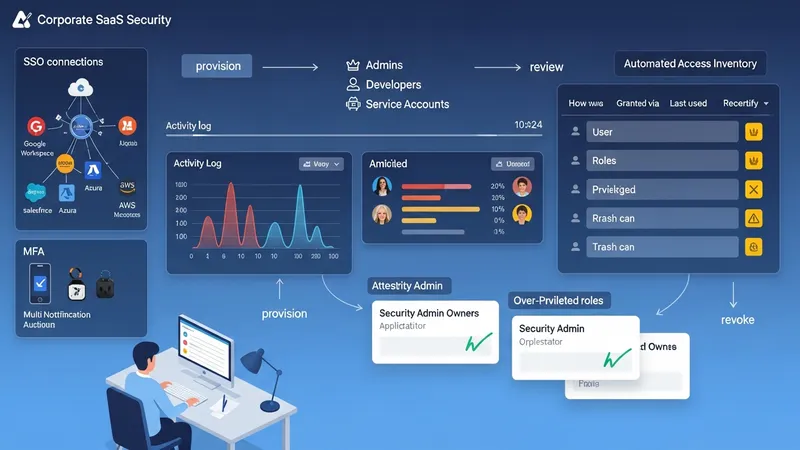
Access review processes may be supported by automated inventories that list who has access to what, how access was granted, and when it was last used. These inventories can facilitate periodic recertification cycles, orphaned account removal, and identification of over-privileged roles. In many cases, organizations combine technical controls with attestations from application owners to validate that access remains appropriate for business needs. Such hybrid approaches typically aim to balance operational continuity with tighter control over sensitive resources.
Service account and API credential management is an area that often requires special attention because machine identities may have broad and long-lived permissions. Good practice in posture monitoring can include discovery of OAuth apps, long-lived keys, and third-party integrations with broad scopes. Highlighting these artifacts and tracking their usage patterns allows teams to prioritize rotation, scope reduction, or removal. Where available, adopting short-lived tokens and constrained scopes can reduce the window of exposure associated with machine credentials.
Integration with identity providers and access management consoles is commonly part of a posture management program to ensure consistent policies across services. These integrations can surface discrepancies in enforcement of policies such as password complexity or session duration. Ensuring that authoritative identity sources are aligned with SaaS platform settings helps reduce configuration drift. Teams often consider mapping identity signals to risk scoring so that anomalous or risky access attempts can trigger heightened monitoring or conditional access responses.
Translating regulatory or internal control requirements into technical checks requires creating mappings between control objectives and observable SaaS artifacts. For example, a requirement to restrict public data sharing can be mapped to checks of sharing defaults, link-scanning settings, and external collaborator lists. These mappings are typically documented so that audit reviewers can follow the rationale behind each check. Organizations often start with a focused set of controls most relevant to their risk profile and broaden coverage as processes mature and additional evidence is needed for assessments.
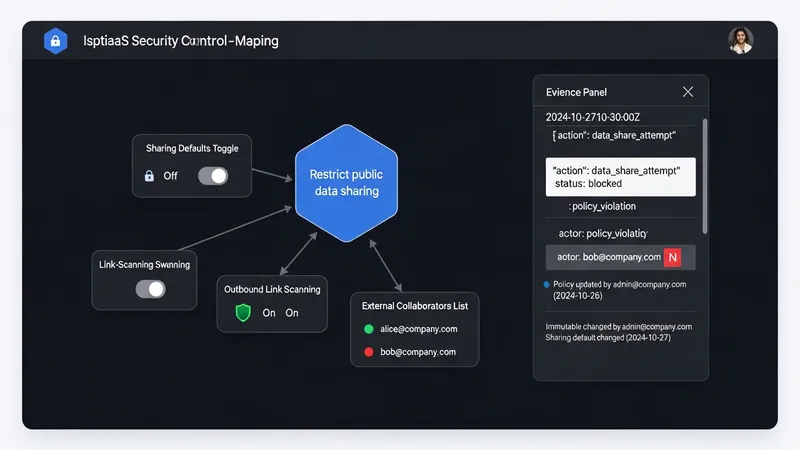
Evidence collection strategies aim to preserve context such as timestamps, API responses, and the identities of accounts that made changes. Captured evidence may be retained for defined periods consistent with internal retention policies and regulatory expectations. When controls are automated, change logs and remediation steps provide traceability for auditors. Reporting functionality can be configured to produce control matrices that align checks to specific clauses or requirements in frameworks commonly used for cloud and SaaS governance.
Framework alignment often leverages established standards or control families rather than attempting to create platform-specific rule sets for every requirement. Mapping to control families such as access control, change management, and logging can simplify coverage and reporting. This approach allows organizations to reuse evidence collected for multiple frameworks and to reduce duplication of effort. Regular reviews of mappings are commonly performed to ensure that changes in vendor features or organizational policy are reflected in control checks.
Maintaining compliance posture frequently involves exception management and documented compensating controls when strict enforcement is not immediately feasible. Exception processes document the rationale, duration, and mitigations for deviations from baseline controls. Over time, exception trends can inform prioritization of remediation work and highlight areas where engineering changes or process adjustments may be needed. The goal of these practices is to ensure that evidence-based decisions guide control deployment and that auditability is preserved.
Continuous monitoring is designed to detect changes that may alter an organization’s exposure between scheduled assessments. Sources often include provider change notifications, audit logs, configuration snapshots, and identity provider events. Effective monitoring solutions correlate these signals to reduce alert noise and to identify high-risk combinations, such as an elevated role assignment coinciding with disabled logging. Operational teams may prioritize tuning notification thresholds and integrating findings into incident response workflows to ensure timely attention to significant deviations.
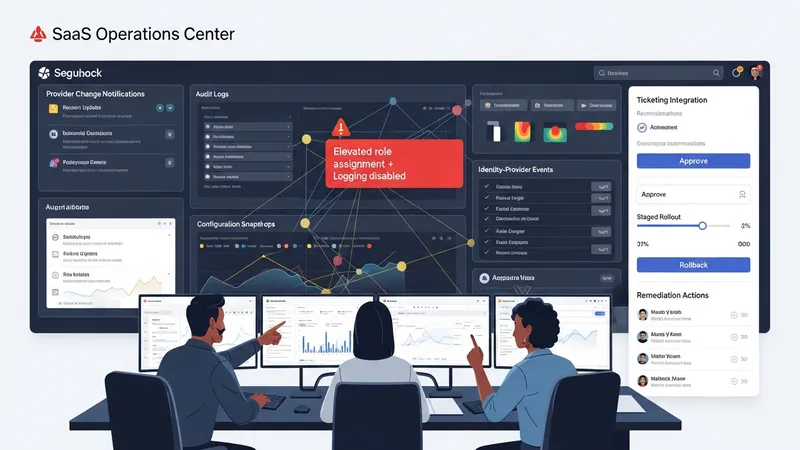
Remediation workflows vary from advisory guidance to automated enforcement, and the choice depends on organizational risk tolerance and the potential impact on users. Advisory workflows generate structured recommendations and integrate with ticketing systems so that owners can validate and apply fixes. Automated or partially automated remediation can shorten exposure windows but typically requires staged rollout, approvals, and rollback plans to prevent unintended disruption. Maintaining clear audit trails for remediation actions supports accountability and post-change review.
Scalability considerations include managing rate limits on provider APIs, handling multiple tenants or organizational units, and normalizing heterogeneous configuration models. Effective implementations use connector orchestration, caching strategies, and careful scheduling to avoid crossing provider thresholds while maintaining timely visibility. Teams may adopt sampling or prioritized scanning approaches for very large estates, focusing more frequent checks on high-risk services or configurations while scheduling broader scans less often.
Program governance encompasses roles, responsibilities, and metrics to measure the effectiveness of posture efforts. Common metrics include number of high-severity findings, time-to-remediate, and coverage of critical applications. Governance arrangements may define who reviews findings, who authorizes automated enforcement, and how exceptions are managed. Over time, these governance practices support continuous improvement by identifying recurring failure modes and informing decisions about control investments and process changes.