
Privileged account management software refers to systems that control, monitor, and log access to accounts with elevated permissions. These tools typically centralize sensitive credentials, enforce temporary access policies, and record privileged sessions so that organizations can reduce unauthorized use of high‑risk accounts. The core concept is to treat elevated access as an auditable, time‑bound activity rather than an open or permanent entitlement.
Such systems often integrate with authentication methods and directory services to apply fine‑grained controls. They may combine credential vaulting, session brokering, multi‑factor authentication, and policy engines to limit the scope and duration of privileged access. The goal is to reduce exposure of shared or static credentials and to provide traceable evidence for security reviews and regulatory compliance.

Credential vaulting and rotation may be deployed as a central repository that integrates with existing identity stores and APIs. These mechanisms often include automated rotation schedules and ephemeral credential issuance for cloud or infrastructure resources. When implemented, they can reduce the period during which compromised credentials remain useful; however, success typically depends on consistent inventory of privileged accounts and integration coverage across systems.
Session monitoring and recording systems typically act as intermediaries or agents that either proxy traffic or collect telemetry. Recorded sessions can be indexed and retained according to policy, which may help with incident investigation and audit review. Analysts note that high‑quality recordings and searchable logs often speed forensic work, though storage and privacy considerations can influence retention periods and access controls for the recordings themselves.
Just‑in‑time elevation workflows commonly leverage role‑based approvals, time limits, and temporary credential issuance to avoid continuous administrative privileges. These workflows can be combined with multi‑factor authentication and single‑use tokens to reduce the window of exposure. Organizations may choose different levels of approval or automated triggers depending on risk tolerance and operational needs.
Policy enforcement and audit logging functions within privileged account management software typically provide alerts, change tracking, and evidence needed for compliance frameworks. When mapped to regulatory requirements, these functions can help demonstrate control implementation during assessments. It is important to recognize that software outputs may support compliance evidence but do not by themselves constitute compliance without organizational policies and processes aligned to the controls.
In summary, these tools aim to centralize credential control, limit standing privileges, and produce auditable records of elevated activity. Implementations may vary in architecture, integration depth, and operational tradeoffs, and effectiveness often depends on organizational processes such as account inventory and access review. The next sections examine practical components and considerations in more detail.
Core technical components commonly found in these systems include a secrets store, a session broker, connectors for directory services, and APIs for automation. The secrets store secures credentials and may support encryption at rest and in transit. Session brokers can proxy protocols like SSH and RDP to capture activity. Directory connectors allow synchronization of user and group data so policies can be applied consistently across resources. APIs enable integration with orchestration tools and cloud providers, which may be necessary in environments that rely on automated provisioning.
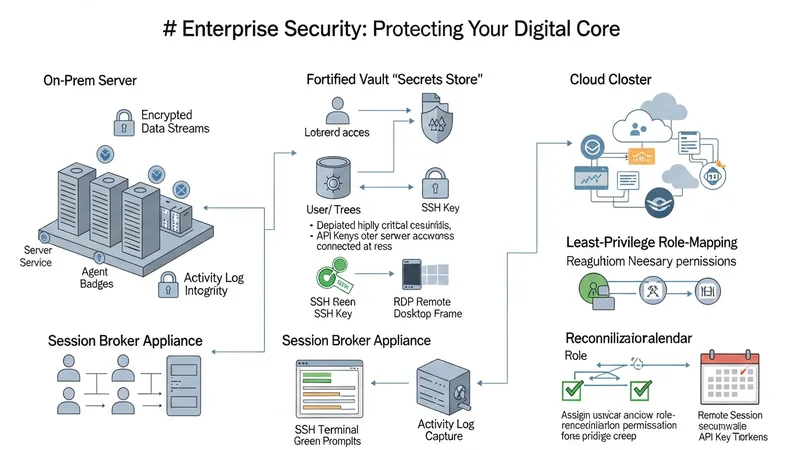
Integration patterns often depend on existing infrastructure: on‑premises environments may use agent‑based connectors, while cloud resources may rely on identity federation and temporary API keys. Where possible, organizations typically aim for least‑privilege mappings between directory roles and privileged roles; this requires careful role design and periodic reconciliation. Automation can reduce human error but may introduce complexity if connectors are not maintained or if API permissions are overly broad.
Encryption and key management are foundational considerations. Secrets stored in a vault may be encrypted using keys managed by an external key management system (KMS) or by the product itself. Access to encryption keys should be limited and auditable to prevent unauthorized retrieval of large sets of credentials. Operational practices such as key rotation schedules and split knowledge controls may be applied to reduce single points of failure.
Scalability and availability planning are also relevant technical concerns. In larger environments, the secrets store and session proxy may need clustering, load balancing, and geographic redundancy. Latency introduced by proxies can affect user workflows, so performance testing and staged rollouts are often recommended as considerations rather than directives. Continued reading explores procedural and compliance aspects that complement these technical elements.
Policy engines in such software allow definitions of who may request access, under what conditions, and for how long. Policies can include approval chains, risk‑based factors, and required authentication strength. Audit logs typically record policy decisions, credential issuance events, and session metadata. When mapped to organizational control frameworks, these records can serve as demonstrable evidence during internal or external audits.
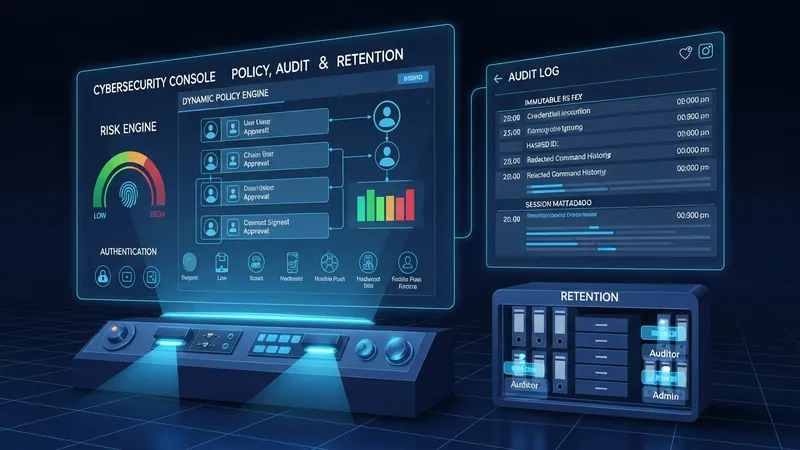
Retention and access to audit data are compliance considerations that vary by jurisdiction and industry. Retention periods may be influenced by regulatory requirements or internal risk assessments; logs often need to be protected with similar controls to those applied to credentials. Access to audit data should be restricted to authorized roles to preserve integrity of evidence and to limit exposure of sensitive command histories.
Segregation of duties is a common policy objective tied to privileged access: approvals and access reviewers are typically separated from those who perform privileged actions. Automated enforcement can help reduce violations, yet organizations may need to define exception workflows for emergency scenarios. Such exception processes should themselves be logged and subject to retrospective review to maintain auditability.
Evidence quality often depends on consistent naming, tagging, and inventory management. When accounts and resources are inventoried and labeled, policy application and audit correlation become more straightforward. Considerations for implementation include establishing a clear account taxonomy, assigning responsibility for review cycles, and documenting mapping between policies and compliance requirements.
Operational adoption typically involves inventorying privileged accounts, defining roles, and mapping existing administrative tasks to controlled workflows. Change management may be necessary to transition from manual practices to automated issuance and rotation. Training for administrators and reviewers is often required so users understand workflows, expected behavior, and how to access logs for investigations.
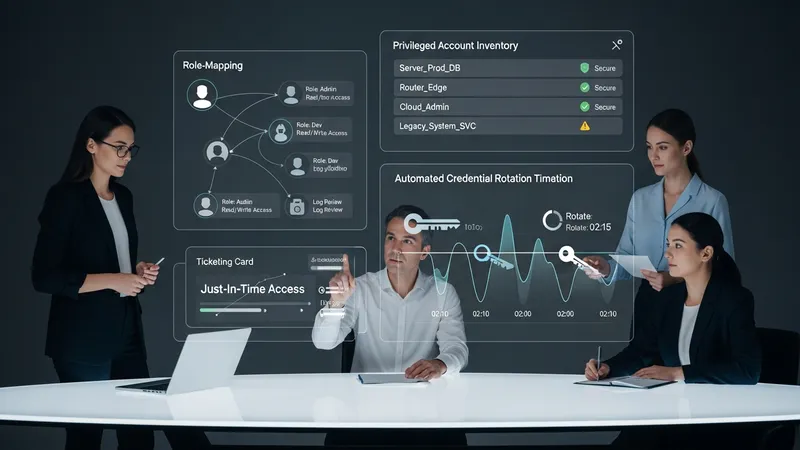
User experience design is a relevant operational factor: overly burdensome workflows can lead to workarounds, while transparent, integrated flows may increase adherence. Common practices include just‑in‑time access, session escalation for specific tasks, and temporary access objectives tied to ticketing systems. Balancing security controls with operational efficiency is a consideration organizations typically address through iterative rollout and metrics tracking.
Monitoring and incident response processes should incorporate privileged activity telemetry into wider security operations. Alerts for anomalous privilege use—such as out‑of‑hours sessions or unusual command patterns—can be fed into a security information and event management (SIEM) system. Playbooks for incident response often include steps to revoke temporary privileges, preserve session recordings, and conduct post‑incident reviews.
Ongoing maintenance practices include periodic access reviews, credential hygiene checks, and connector health monitoring. Access reviews may be scheduled quarterly or more frequently depending on risk appetite, and they typically require coordination between system owners and auditors. These operational considerations support sustained control effectiveness rather than being one‑time tasks.
Privileged account controls often map to regulatory and standards frameworks that require access control, logging, and accountability. When aligning controls to frameworks, organizations may document how credential vaulting, session recording, and approval workflows address specific control objectives. This mapping typically helps compliance teams demonstrate that technical controls exist and are operated according to policy.

Risk reduction is commonly framed in terms of limiting attack surface and improving detection. By reducing the number of standing administrative accounts and introducing temporary credentials, organizations may decrease the avenues available to attackers. Session recordings and immutable logs can provide forensic trails that assist in determining scope and impact when incidents occur.
Implementing these controls also introduces secondary risks and obligations, such as the need to secure audit logs, manage retention, and protect recorded session content from unauthorized disclosure. Organizations often treat these as part of the overall risk register and apply compensating controls where necessary, such as encrypting stored recordings and restricting access to those records.
Evaluation of control effectiveness may use metrics such as the number of privileged accounts, percentage under vault control, frequency of rotation, and time to revoke temporary credentials. These measurements can provide visibility into program maturity and inform iterative improvements. The final section invites review of governance and maturity considerations linked to privileged account management practices.